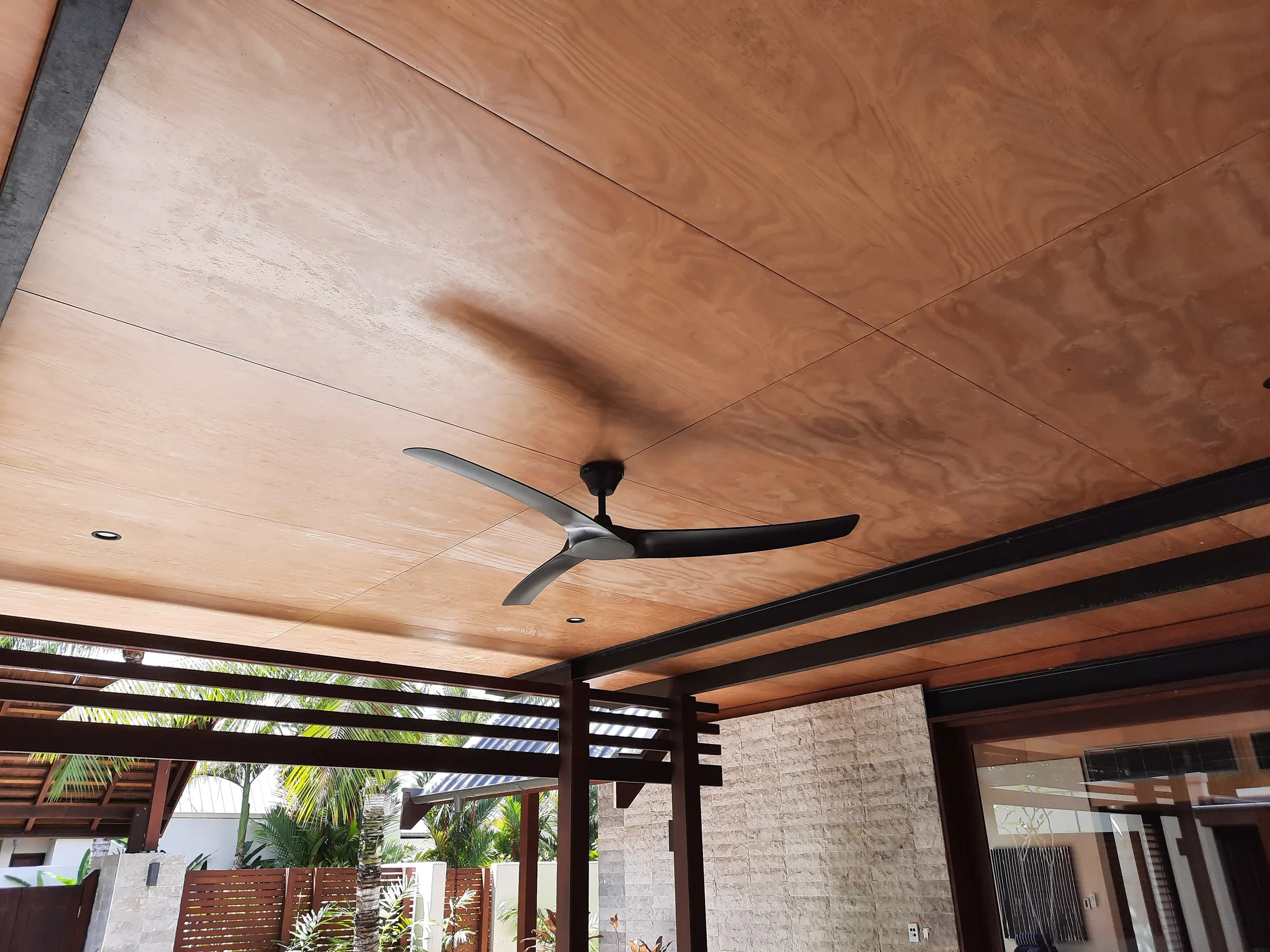
Electrical problems
Ceiling fan not working or running slow
Coastal salt air kills fan motors and capacitors faster than anywhere else in the country. Sometimes it is the capacitor, sometimes the fan is simply finished.
- 5.0 on Google
- 24/7 emergency callout
- Licence 82270
Check these few things first
If the fan hums but will not start, or only runs on the fastest speed, that is a failed capacitor almost every time. If the fan is completely dead, no hum and no light, the problem is more likely power getting to the fan than the fan itself.
Before you ring anyone, work through this in order.
- Check every wall switch in the room. Plenty of fans are wired with one switch for the fan and another for the light, and the wrong one gets knocked off during cleaning.
- Wind the speed control or pull chain all the way up, not to the lowest setting.
- If it is a remote controlled fan, put fresh batteries in the handset first. Handsets fail far more often than the receiver in the canopy does.
- Look at the switchboard. Reset a tripped circuit breaker or safety switch once. If it trips again straight away, leave it off and call us, because something on that circuit is faulting.
- Check whether other lights or power points in the same room are dead too. If they are, it is a circuit problem and fault finding is the job, not fan repair.
What it usually turns out to be
Most fan faults fall into a short list.
Capacitor failure. The capacitor gives the motor the kick it needs to start, and it sets the speed steps. When it fails you get a fan that hums and sits there, a fan that needs a shove to get going, or a fan stuck on one speed. Heat and humidity shorten their life, and in Far North Queensland fans run most of the year.
Remote or receiver failure. Batteries first, then pairing. If new batteries and a fresh pairing do nothing, the receiver in the canopy has usually cooked. On some fans we can replace it. On cheap ones it is the only control path, so the whole fan goes.
Wall control failure. Old capacitor type speed controllers wear out and either stick on one speed or buzz loudly. Fit the wrong type of controller for the fan and you get the same symptoms, so we check what is on the wall.
Salt air in the motor. On blocks near the water at Port Douglas and Four Mile, salt gets into the bearings and the winding of outdoor and veranda fans. The fan gets noisier over a season or two, then slows, then stops. Once the bearings are gone there is nothing to repair.
Wobble is not an electrical fault. A wobbling fan is nearly always blade balance or a loose mounting bracket in the ceiling. One blade sitting a few millimetres lower than the others sets up the wobble. A ticking or clicking fan is usually the downrod, the ball joint at the top, or a canopy screw that has come loose.
What not to do
Do not pull the canopy down and start poking at the wiring. In Queensland, testing and locating faults is energised electrical work. It has to be done by a licensed electrician with the right gear.
Do not fit a capacitor you bought online because it looked the same. The microfarad value has to match the motor. Fit the wrong one and you overheat the winding and turn a cheap repair into a new fan.
Do not keep running a fan that is grinding, ticking loudly or wobbling badly. That is a heavy lump of metal spinning on a bracket in your ceiling. Turn it off at the wall and leave it off.
Do not put a light dimmer on a fan circuit. It will not control the speed and it will damage the motor.
Repair or replace, honestly
A capacitor, a receiver, a wall control, a loose mount or a balance problem are all worth fixing, especially on a good quality fan. A motor with failed bearings is not. Neither is a sealed cheap fan with no parts available, or an outdoor fan gone chalky from salt. We will tell you which one you have got before we do anything.
What we do when we get there
We isolate the circuit, test that the fan is actually dead rather than switched off somewhere, and check voltage at the fan point. Then we drop the canopy, test the capacitor and receiver, check the mounting bracket and the earth, and spin the motor by hand to feel the bearings. Most faults are sorted in the one visit off the van. If it needs replacing we will talk through what suits your ceiling height and how exposed the spot is. Our ceiling fan page covers supply and install. Give us a ring on (07) 4099 3497.
Source: WorkSafe Queensland, testing is energised electrical work, worksafe.qld.gov.au
Straight answers
Ceiling fan not working: your questions
What does it cost to fix a ceiling fan?
A ceiling fan repair is priced once we have tested the fan. The same symptom can be a capacitor swap or a dead motor, so we do not quote a fan repair sight unseen. We come out, test the fan and tell you what it is and what it will cost before we do any work. If the fan is not worth repairing, we say so and price a replacement instead, including the fan and the install. Ring the office on (07) 4099 3497 and we will book a time that suits.
Can I change a ceiling fan capacitor myself?
No. Replacing a capacitor means opening the fan housing and working on the wiring inside, which is electrical work and has to be done by a licensed electrician in Queensland. There is a second problem too. The capacitor has to match the motor, and the value stamped on the old one is often faded, or the fan has been repaired before with the wrong part. We carry common values on the van and match them properly.
Why do my outdoor fans fail so much faster than the ones inside?
Salt air. Anywhere within a few kilometres of the water at Port Douglas, Craiglie or the beaches, salt settles on the motor housing and works into the bearings and the winding. Wet season humidity does the rest. An indoor fan can run fifteen years, while a standard fan on an exposed veranda might get five. If you are replacing an outdoor one, it is worth spending more on a coastal rated fan with a sealed motor, stainless fixings and polycarbonate blades. Polycarbonate does not rust and it wipes clean, which is why it is what we fit almost everywhere now.
My fan works but it wobbles. Is that dangerous?
It is worth sorting, though it is usually not an electrical fault. Most wobble comes from blade balance, a warped blade, or a mounting bracket that has worked loose in the ceiling. A small wobble is a nuisance. A big one puts load on the bracket and the joist over time. Turn it off, check whether one blade sits lower than the others, and if the mount feels loose at all, leave the fan off until we can look at it.
Other things that go wrong
Common electrical problems in the Douglas Shire
Ceiling fan not working? We will find the actual cause.
Leave us a number and we will ring you back, or send the whole job through and we will quote it.