Electrical problems
Power point not working
One dead power point is usually a tripped circuit, a failed accessory or a loose connection. In the tropics it is often moisture or an ant nest.
- 5.0 on Google
- 24/7 emergency callout
- Licence 82270
Start at the switchboard, then test the point with something you know works
Go and look at your switchboard first. If a circuit breaker or safety switch has flicked down, or is sitting halfway, that is your answer and the rest of the page tells you what caused it. If everything at the board is still up, plug a lamp or a phone charger you know is working into the dead point, and try both sockets on it.
What to check first, in this order
- Look at every switch in the board, including the safety switches. A tripped one often sits in the middle rather than fully down.
- If something has tripped, unplug everything on that circuit, then push the switch firmly off and back on. If it holds, plug appliances back in one at a time until it trips again. That appliance is your fault.
- If it will not reset, leave it off and ring us. Forcing it does nothing except energise a fault.
- If nothing has tripped, walk the house and note which points work and which do not. Rooms, not just the one point. That map saves us time when we arrive.
- Check whether the point is controlled by a wall switch, which is common for beds, fridges and outdoor areas.
What it usually turns out to be
Most points are wired in a loop. The cable comes into one point, terminates there, and carries on to the next. One failed terminal screw takes out everything downstream of it. So a single dead point in the hallway can be caused by a connection in the bedroom you never think about. It is also why "the whole back half of the house is out" is such a common call for us.
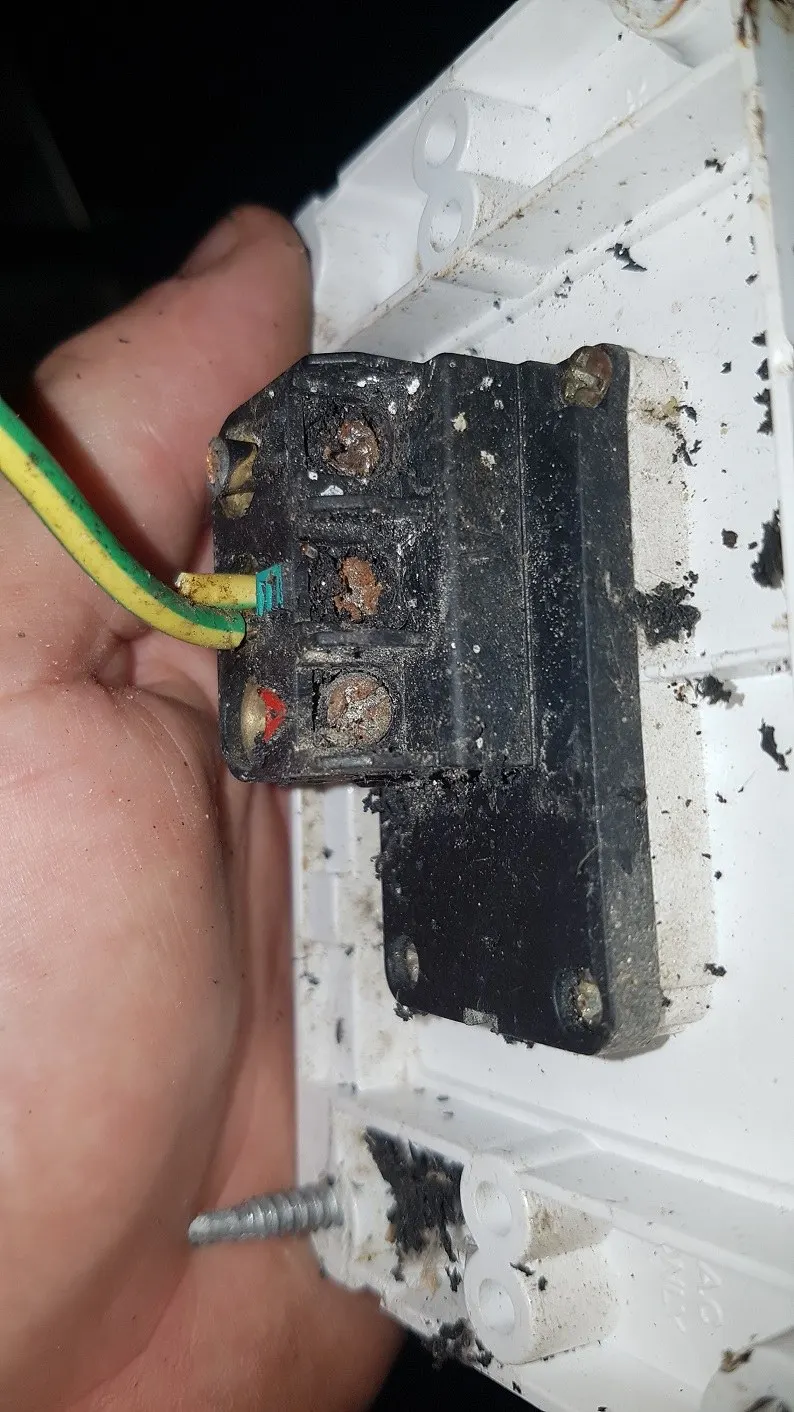
Loose terminations are the number one cause. Screws back off slowly over years of heating and cooling, the connection starts arcing, and eventually it opens up. Second on our list up here is water and wildlife. Outdoor and patio points cop wet season humidity, driving rain and salt air off the water, and ants love a weatherproof enclosure. We pull covers off points in Craiglie, Port Douglas and out on the acreage blocks and find a full nest packed around live terminals. Geckos do the same. After heavy rain or a blow, an outdoor point that has taken water in behind the plate will either be dead or will trip the safety switch every time you plug something in.
Then there is damaged cable from a picture hook or a screw, rodents in the roof space, and older points where the socket contacts are simply worn out and the plug falls loose.
One that is different: if the point is warm to touch, browned or discoloured around the pins, smells like hot plastic, or buzzes or crackles when you plug something in, treat that as urgent. That is a connection arcing behind the plate. It is a fire risk, not an inconvenience. Turn that circuit off at the board and ring us on (07) 4099 3497. We run a 24 hour callout every day for exactly this.
What not to do
Do not take the plate off to have a look. In Queensland, testing and locating faults is classed as energised electrical work, so it is licensed work even before anything is repaired. A point can also carry conductors from more than one circuit. Switching off the breaker you think feeds it does not guarantee the terminals behind it are dead.
Do not keep resetting a breaker that keeps tripping, do not use a point that is warm or discoloured, and do not let an extension lead across the floor or out into the yard become the permanent fix. The Electrical Safety Office also recommends pressing the test button on your safety switches every three months. That catches a lot of problems before they become a dead circuit.
What we do when we get there
We test at the board to confirm which circuit is affected and whether the breaker or safety switch is the problem. Then we work back along the loop, isolating and pulling points until we find the failed termination. Insulation and polarity testing tells us whether it is a wiring fault or an appliance. From there it is re-terminating properly, replacing damaged or corroded power points, sealing and re-mounting outdoor points so the ants stay out, and issuing a Certificate of Testing and Compliance for the work. If the fault is deeper in the installation we move into full fault finding, which is the single biggest thing we do.
Sources: WorkSafe Queensland, testing as energised electrical work; Electrical Safety Office, safety switches; WorkSafe Queensland, certificates of compliance.
Straight answers
Power point not working: your questions
Can I just replace the power point myself?
No. Replacing or repairing a power point is licensed electrical work in Queensland, and so is testing it to find out why it stopped. The wiring behind a point is rarely as simple as it looks. Loop wiring means several cables land on the one set of terminals, and some points carry conductors from more than one circuit. Turning off the breaker you think feeds it is not proof the terminals are dead. Changing the plate yourself also leaves you without a Certificate of Testing and Compliance, which matters for insurance and for rentals.
Why did half the house go out when only one power point failed?
Because of loop-through wiring. The cable runs into one point, terminates on those screws, and continues on to the next point in the circuit. Every point downstream is fed through those terminals. When one screw works loose or burns out, everything past it on that circuit dies at once, even though the point that failed might still look perfectly normal. This is why we rarely find the fault at the dead point itself. We usually find it at the last one that still works.
How much will it cost to fix a dead power point?
Fixing a dead power point is charged on the time and materials the job actually takes, and we tell you what we have found before we carry out the repair. We do not quote a figure over the phone, because until we test we do not know whether it is one loose screw, a water damaged outdoor point, or a damaged cable in the roof. For larger work, like replacing a run of points, adding new circuits or a switchboard upgrade, we come out, look at it and give you a written quote first.
The point works but it is warm and going brown. Can it wait until next week?
No. Heat and browning around the pins means the connection is arcing, either inside the point or at the terminals behind it. Arcing inside a wall cavity is how electrical fires start. Stop using it, switch that circuit off at the switchboard, and ring us on (07) 4099 3497. We run a 24 hour emergency callout every day of the year, and this is one of the calls we want to take straight away rather than a week later.
Other things that go wrong
Common electrical problems in the Douglas Shire
Power point not working? We will find the actual cause.
Leave us a number and we will ring you back, or send the whole job through and we will quote it.