Port Douglas · Douglas Shire · Cairns Northern Beaches
EV charger installation, sized to what your supply will carry
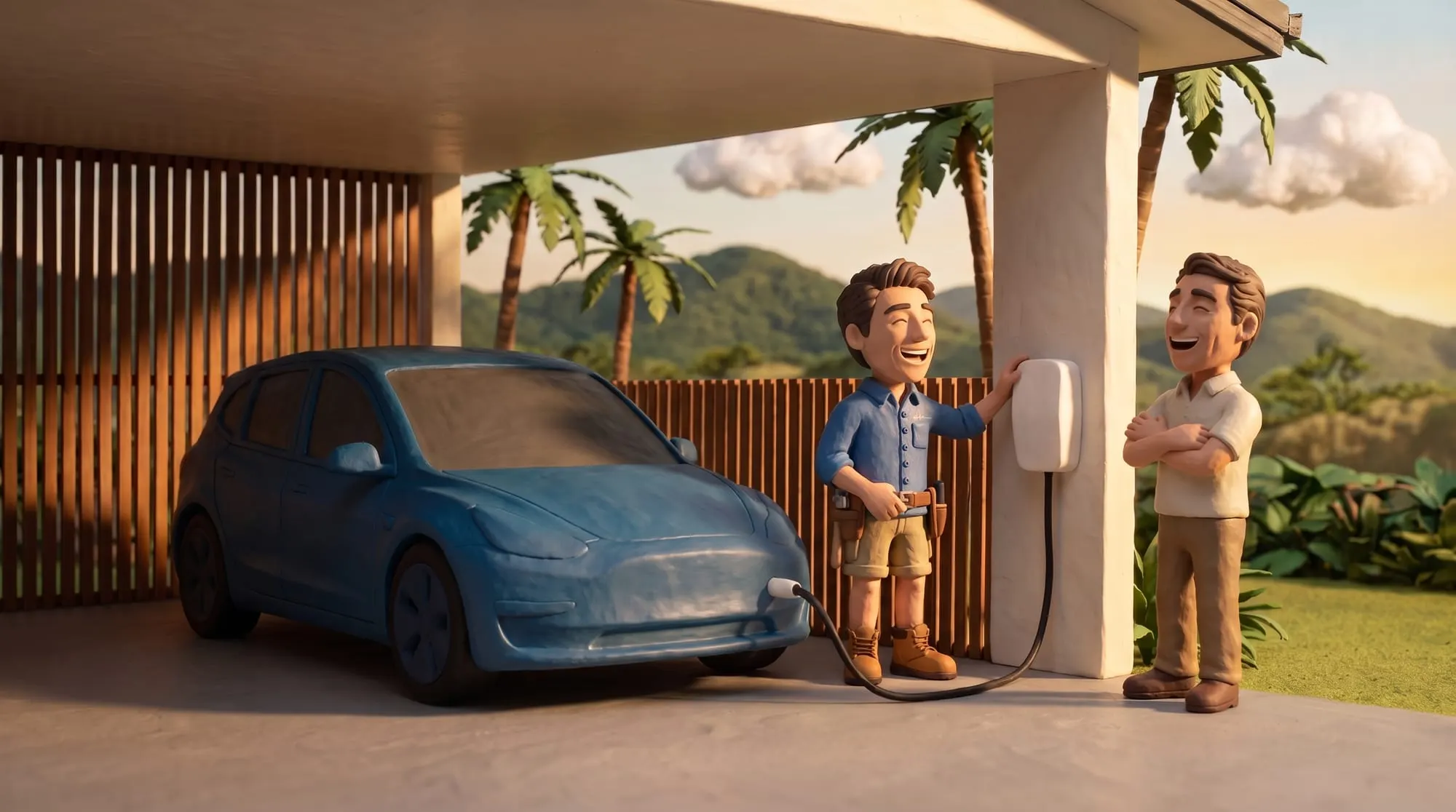
Chargers for houses, apartment blocks, resorts and workplaces, from a single point in a carport through to a metered, load managed bank in a basement car park. Straight advice on what your supply will actually carry.
- 5.0 on Google
- 24/7 emergency callout
- Licence 82270
What does an EV charger need from your switchboard, and what does Ergon need to know?
Hanging the charger on the wall is the easy part. The job is everything behind it: whether your supply can carry another 32 amp circuit, what Ergon will allow on a single phase connection, and how the cable gets from the switchboard to where the car actually parks. The question is nearly always the same, the car arrives in three weeks and what has to happen first, and the honest answer is that somebody has to look at your board before anyone can tell you.
What decides whether a charger goes in cleanly is not the charger. It is the switchboard, the mains, what the supply has spare and what the network will allow, and that has been our work since 2007. Boards and mains upgrades, load logging on buildings already running close to their limit, sub-metering that bills the right lot, and the Ergon paperwork that goes with all of it. A charger is a dedicated circuit on a compliant board with a connection the network has approved. Same job, newer load.
Up here that matters more than it does down south. A lot of houses around Port Douglas, Craiglie and Mossman are on older boards that were never sized for another heavy circuit. And a very large share of the parking in this town is common property in an apartment block or a resort, which changes the question completely.
Single phase, and the 20 amp rule in Queensland
Most houses around here are on a single phase supply, which puts you at a charger up to about 7 kW. That is somewhere near 40 km of range for every hour it is plugged in, depending on the car, so it fills the battery overnight with hours to spare.
The catch is a Queensland one and it surprises people. Under the Queensland Electricity Connection Manual the general equipment limit on a single phase connection is 20 amps, and anything above that has to have active device management on it. That includes the common 32 amp 7 kW units. So a 20 amp charger goes in and that is the end of it. A 32 amp charger goes in under one of three arrangements: an economy tariff using a network device, a primary tariff with basic active management via a network device, or a primary tariff with a dynamic connection. Which of the three is available depends on your site. We work that out and lodge the paperwork before we quote, so nobody finds out afterwards that the charger has to run at half speed.
Three phase skips the device management altogether
Worth knowing before you rule it out. Ergon allows a dedicated 22 kW three phase charger, 32 amps per phase switched simultaneously across all three, to be connected without any of the arrangements above. No network device, no dynamic connection, nothing winding it back at peak times.
On a house the catch is the car rather than the wiring. A 22 kW charger only charges faster if the vehicle can take it, and most electric cars sold in Australia cap out at 7.4 kW or 11 kW on board, so bringing three phase in purely for a charger is rarely worth the money. If three phase is already at the property it is the cleaner connection by a distance. On a resort or a block of units, where the supply is three phase already and there are several chargers to feed, it is almost always the answer.
What has to be at the switchboard
The Wiring Rules want a charger on its own dedicated circuit, not sharing with anything, with its own protection and a safety switch (RCD) suited to the equipment. Where the charger cannot detect a DC fault itself, the safety switch upstream has to be a type that can. Better units handle that internally and cheaper ones do not, so if you have already bought a charger online, tell us the model and we will check it before anything gets ordered around it.
Then there is capacity, and that is where the surprises live. A 32 amp circuit is a serious load on top of the hot water system and the cooking. If the board is a rewirable ceramic fuse board, if there is no room left on it, if the existing circuits have no safety switch protection, or if the mains are undersized, that gets sorted first. Plenty of boards are fine as they are and we will tell you so. If yours is not, our switchboard upgrades page sets out what is involved.
Apartment blocks, body corporates and resort car parks
An owner wants a charger in their bay. The bay is either common property or exclusive use, and either way the cable has to cross common property to get there. In Queensland that makes it an improvement to common property, so it needs body corporate approval, and whether the committee can approve it or it has to go to a general meeting depends on what it costs.
Committees are right to be cautious, and from the body corporate work we already do, the real reason is rarely the one said out loud. It is that saying yes to the first owner, on a cable run designed around one bay, quietly makes owners two through eight harder and dearer. Design the building once, then let owners connect to it one at a time.
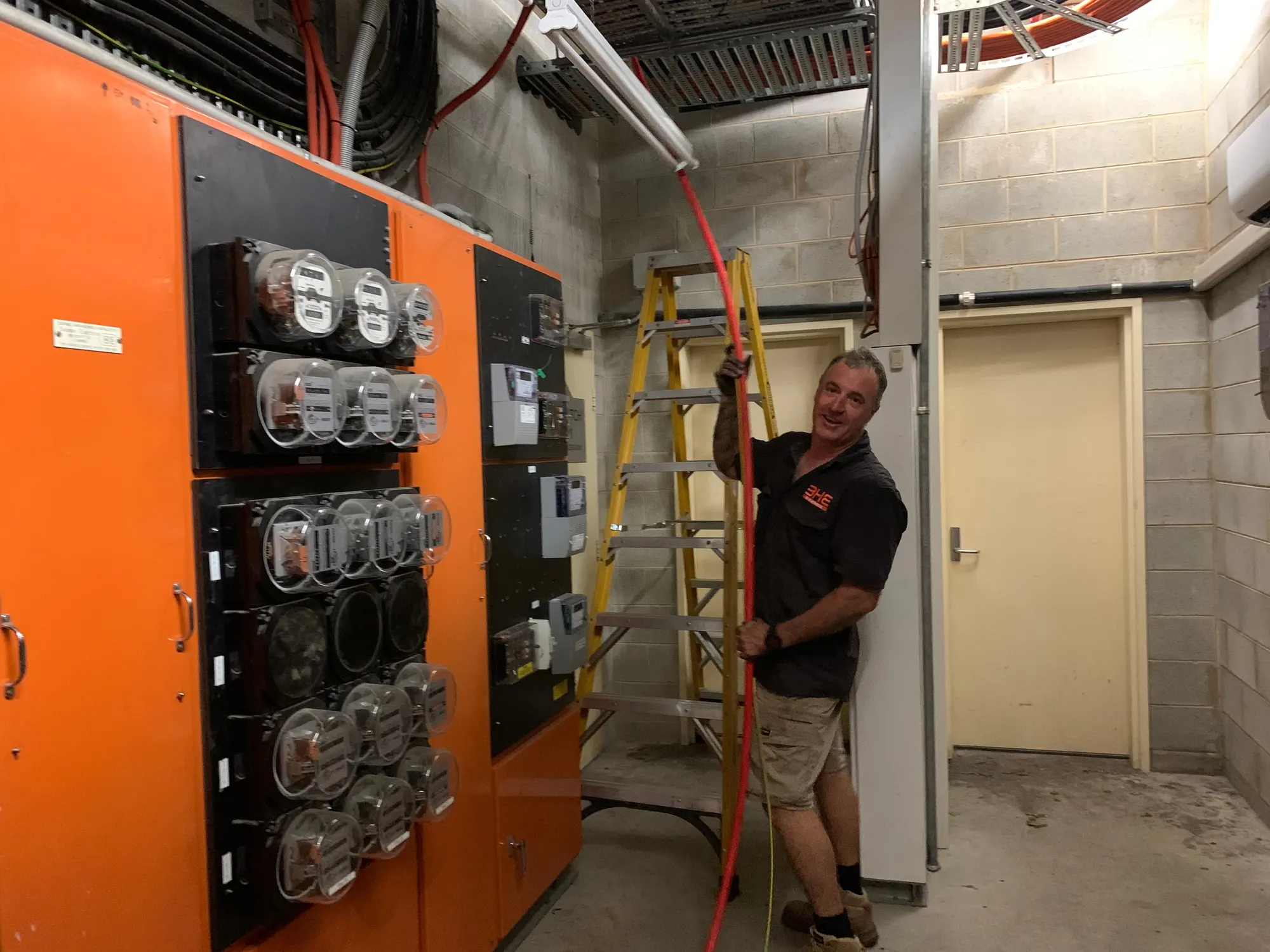
- Find out what the building actually has spare. Not what the drawings say. We log the main switchboard over a week and hand the committee a real maximum demand figure, so the decision gets made on numbers instead of opinions.
- Load management, so the supply stops being the reason to say no. A managed system shares whatever headroom exists across every charger and winds them all back together when the building is busy. Six managed chargers will often fit where two unmanaged ones will not.
- Meter every charge point to the lot that uses it. Who pays for the electricity stalls more of these projects than anything technical. Metered properly the argument never starts, and the body corporate is not quietly funding one owner’s fuel.
- Size the infrastructure for later, not for now. Tray, spare ways and a sub board put in on the first visit cost very little next to going back into a finished basement a second time.
We write these quotes the way a committee has to read them: scope, cost, why it is needed, what happens if it is deferred, and what it does to the next six requests. Same as we do on strata and body corporate work already. If the answer is sub-metering, that is our metering work. If the answer is that nobody knows what the building has spare, that is power quality logging.
Guest charging at a resort
Guests turn up in electric cars and ask at reception where to plug in. The engineering is the same as a block of units, but the decisions are different: where the chargers go so staff can see them, how they survive a reversing hire car, how you stop one guest sitting on a charger for two nights, and whether charging is free, included in the tariff or paid for. We do a lot of work in resorts and accommodation already, so staging it around guests and bookings is familiar.
BH Electrics is a licensed Queensland electrical contractor, licence 82270, based in Craiglie. Brad and Leanne Sims run it, with four electricians and two apprentices, and we are fully insured. Installation work comes with a Certificate of Testing and Compliance. Ring by 2pm on a business day and a commercial job gets attended that day.
Sources: Ergon Energy, EV charging and connections, Queensland Government, improving common property and lots and WorkSafe Queensland, certificates of compliance. Standard: AS/NZS 3000, the Wiring Rules, 2018 edition.
Who we do it for
We do this work for homeowners, businesses, property managers, body corporates and resorts.
Straight answers
EV Charger Installation: your questions
Can I just plug an electric car into a normal power point?
You can, and it will work, but it is a backstop rather than a plan. A standard 10 amp power point gives you around 2.3 kW, which is roughly 10 to 15 km of range an hour. Fine if you drive to the shops and back. Useless the night before a run to Cairns and back. A dedicated charger on its own circuit is several times faster and, more to the point, it is designed to sit at full load for hours at a time. A general purpose power point and an extension lead are not.
What does it cost to get an EV charger put in?
The cost of an EV charger install depends almost entirely on the run from the switchboard to where the car parks. A charger on a wall three metres from a modern board with a spare way is a short job. The same charger on the far side of the house, chased into block work, on a board that is full and mains that are undersized, is a different piece of work altogether, which is why we do not publish rates. Tell us where the car parks, where the switchboard is and what the wall between them is made of, and we will look at it and price it properly. Nothing gets added afterwards.
Do I need three phase power for an EV charger, or will single phase do?
Single phase will do for almost every house. It gives you around 7 kW, which is roughly 40 km of range an hour and more than enough overnight for normal driving. Three phase has one real advantage worth knowing about: Ergon allows a 22 kW three phase charger to be connected without the device management a 32 amp single phase charger needs. But a 22 kW charger only charges faster if the car can take it, and most electric cars sold in Australia cap out at 7.4 kW or 11 kW on board. So if three phase is already at the property, an 11 kW unit is normally the sensible pick and it is a clean install. Bringing three phase in purely for a charger is rarely worth the money on a house. On a resort or a block of units with several chargers, the answer is usually yes.
Do I have to tell Ergon I am putting an EV charger in?
In most cases yes, and it is our job to sort out, not yours. Under the Queensland Electricity Connection Manual the general limit on a single phase connection is 20 amps, and a dedicated charger above that has to have active device management on it. So a 20 amp charger is straightforward, and a 32 amp charger goes in under one of three arrangements: an economy tariff using a network device, a primary tariff with basic active management via a network device, or a primary tariff with a dynamic connection. We check which of those your site can have before we quote, and we lodge the electrical work request, so the answer is not a surprise after the gear is on the wall. A 22 kW three phase charger does not need any of it.
Will my switchboard cope with an EV charger, or does it need upgrading first?
Sometimes it copes and sometimes it does not, and it is not something to guess at. What we look at is whether there is physical room for another way, whether the existing circuits have safety switch protection, whether the mains can carry a 32 amp circuit on top of the hot water and the cooking, and what condition the enclosure is in after a few wet seasons. A rewirable ceramic fuse board will need doing. Plenty of boards from the last twenty years are fine as they stand. We will tell you straight either way rather than selling you a board you do not need.
We are a body corporate and owners are asking for EV chargers. Where do we start?
Start with what the building has spare, not with a quote for one charger. We log the main switchboard for a week and give the committee a real maximum demand figure, then design the building once so owners can connect to it one at a time instead of each install being its own argument. Two things make the difference. Load management shares the available capacity across every charger so the supply stops being a reason to say no, and metering each charge point to the lot that uses it settles who pays for the electricity before it becomes a dispute. Installing a charger in a car park is normally an improvement to common property, so it needs body corporate approval, and whether the committee can approve it or it has to go to a general meeting depends on the cost. We write the quote so it can be put to a vote.
Is there a Queensland rebate for a home EV charger?
No. There is no Queensland rebate for installing a charger at home. The Queensland Zero Emission Vehicle Rebate Scheme, which was for buying the car rather than the charger, closed on 2 September 2024, and the state charging infrastructure co-fund was for public fast charging and closed to applications in February 2023. Registration and duty concessions for zero emission vehicles are a separate thing and they are between you and Transport and Main Roads. If a new scheme opens we will say so on our EV charger page rather than leave it vague.
Where
We do this from Cape Tribulation down to Smithfield
Anywhere on our patch. Every area we cover has its own page with the access and the local conditions on it.
Need a licensed electrician who turns up?
Leave us a number and we will ring you back, or send the whole job through and we will quote it.