Electrical problems
Half the house has no power
Half a house going dark usually means one phase has dropped or a main switch has tripped. Check the neighbours before you call anyone.
- 5.0 on Google
- 24/7 emergency callout
- Licence 82270
Look outside before you touch anything
Half a house going dark comes down to one of two things. Either the network has dropped a phase somewhere in the street, or one of your own main switches or incoming phases has let go at the switchboard. Before you start flicking switches, walk out the front and look at the neighbours. If their lights are off too, or the streetlights are out, it is a network fault and Ergon Energy is the call, not us. Nothing at your switchboard will fix it.
If everyone else is fine and it is only your place, open the switchboard and have a look. Note which switches are off and which rooms are dead. On most houses in Craiglie and Port Douglas that is enough for us to know what we are walking into.
One thing to check straight away. If lights in one part of the house are unusually bright, almost glaring, while lights in another part are dim, orange or flickering, turn the main switch off and ring us immediately. That is the pattern of a lost neutral and it can cook appliances while you stand there watching.
Single phase, two phase, three phase, in plain terms
A single phase house has one live conductor coming in and one main switch. If that drops, the whole house goes off, not half of it. Larger homes, and anything with ducted air conditioning, a pool, a bore pump or a big shed, often have two or three phases coming in. Each phase has its own main switch and feeds its own group of circuits. That is why losing one takes out a clean chunk of the house while the rest carries on. Lights working in the kitchen and nothing in the bedrooms is textbook.
What it usually turns out to be
Most often it is a main switch or a safety switch that has tripped on one phase, taking every circuit behind it. Sometimes there is a genuine fault sitting behind it. Sometimes an appliance has failed and dragged the whole phase down with it.
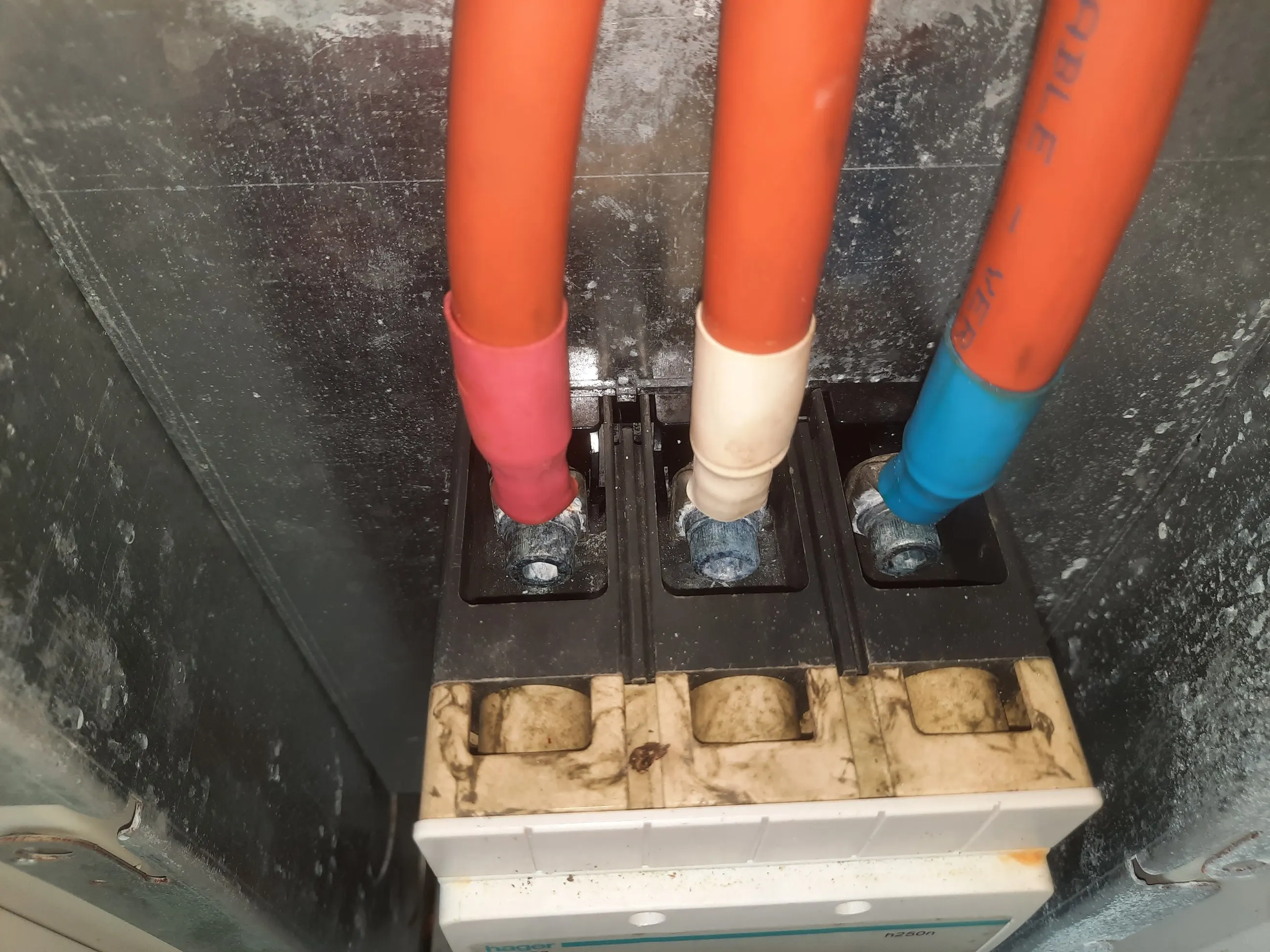
Next most common is the supply itself. Up here the connections at the point of attachment and inside the meter box take a hammering from salt air, and corroded or loose terminations heat up and eventually fail. Wet season water finds its way into meter boxes. Ants, green ants especially, and geckos build up inside enclosures and across terminals, and we pull them out of switchboards constantly. After a blow, a branch through the service mains will do it too.
The dangerous one is a broken or high resistance neutral. The neutral is the shared return path. When it fails on a multi phase supply, the phases start referencing each other through your appliances instead, so voltage climbs on the lightly loaded side and collapses on the other. Televisions, fridges, air conditioner control boards and pool equipment do not survive that for long.
What not to do
Do not sit there resetting a main switch that will not stay on. Each reset re-energises the fault. Do not touch anything on the supply side of the meter or break a seal, that is network property and it is live even with your main switch off. Do not run extension leads from the live half of the house into the dead half, especially not out to a shed or anywhere that gets wet, and never backfeed a generator through a power point. And do not go poking at it with a multimeter from the hardware store. In Queensland, testing is expressly energised electrical work, and that includes locating faults, so it is licensed work whether you find the problem or not.
What we do when we get there
First job is proving which side of the meter the problem is on, because that decides who fixes it. We measure each phase and check neutral integrity under load rather than guessing, then work back through the switchboard, checking terminations for heat and discolouration and splitting circuits to isolate the faulty one. Where a fault comes and goes we can leave a logger on it. If it turns out to be storm damage on your side, the repair has to be tested before the supply goes back on.
We do fault finding every day. It is our single biggest job type. If the switchboard itself is past it, we will tell you plainly what a switchboard upgrade involves before you commit to anything. Emergency callout is available 24 hours, every day. Ring (07) 4099 3497.
Sources: WorkSafe Queensland, testing as energised electrical work; Electrical Safety Office, electrical safety during storms.
Straight answers
Half the house has no power: your questions
The neighbours still have power. Does that automatically mean it is my problem to pay for?
Not always. The supply from the street to your meter can fail on its own without affecting anyone else, and a corroded connection at your point of attachment will only ever take your place out. What it does mean is that someone has to prove which side of the meter the fault sits on. We check that first, before anything else. If it lands on the network side we will tell you and you deal with Ergon. There is no point us pulling your switchboard apart for a fault that is out on the pole.
Can I just turn the main switch back on myself?
Switching a main switch or a safety switch back on is fine, you are allowed to do that. What you should not do is keep resetting one that refuses to stay on, because every reset puts voltage back onto a fault you cannot see. Try it once. If it holds, note what you were using at the time, because an appliance is the likely culprit. If it trips straight back out, or trips again within minutes, leave it off and ring us. Anything beyond that switch, including testing to find why, is licensed work in Queensland.
What does it cost to fix power out to half the house?
Fixing power out to half the house is priced on what the diagnosis finds. It can be a loose terminal or a failed underground supply that needs a trench, so we cannot put a number on a page. We attend, diagnose, then tell you what we have found and what the repair involves before we do it. If it is bigger than a straightforward fix, you get a written quote and you decide. We do not start significant work on a house without the owner knowing what they are agreeing to.
My lights went very bright and then dim before half the house died. Is that related?
Yes, and it is the version we want to hear about straight away. Bright at one end of the house and dim at the other points to a failed neutral, where your appliances end up carrying voltage they were never designed for. Fridges, air conditioners, televisions and pool controllers are usually the first casualties. Turn the main switch off, leave it off, and ring us on (07) 4099 3497 rather than waiting until morning. We run emergency callout 24 hours, every day, and this is exactly what it is for.
Other things that go wrong
Common electrical problems in the Douglas Shire
Half the house has no power? We will find the actual cause.
Leave us a number and we will ring you back, or send the whole job through and we will quote it.