Advice · Safety
Safety switch or circuit breaker? They do completely different jobs
One protects the wiring in your walls. The other protects the people in your house. A great many switchboards in this region have only the first.
The question that matters
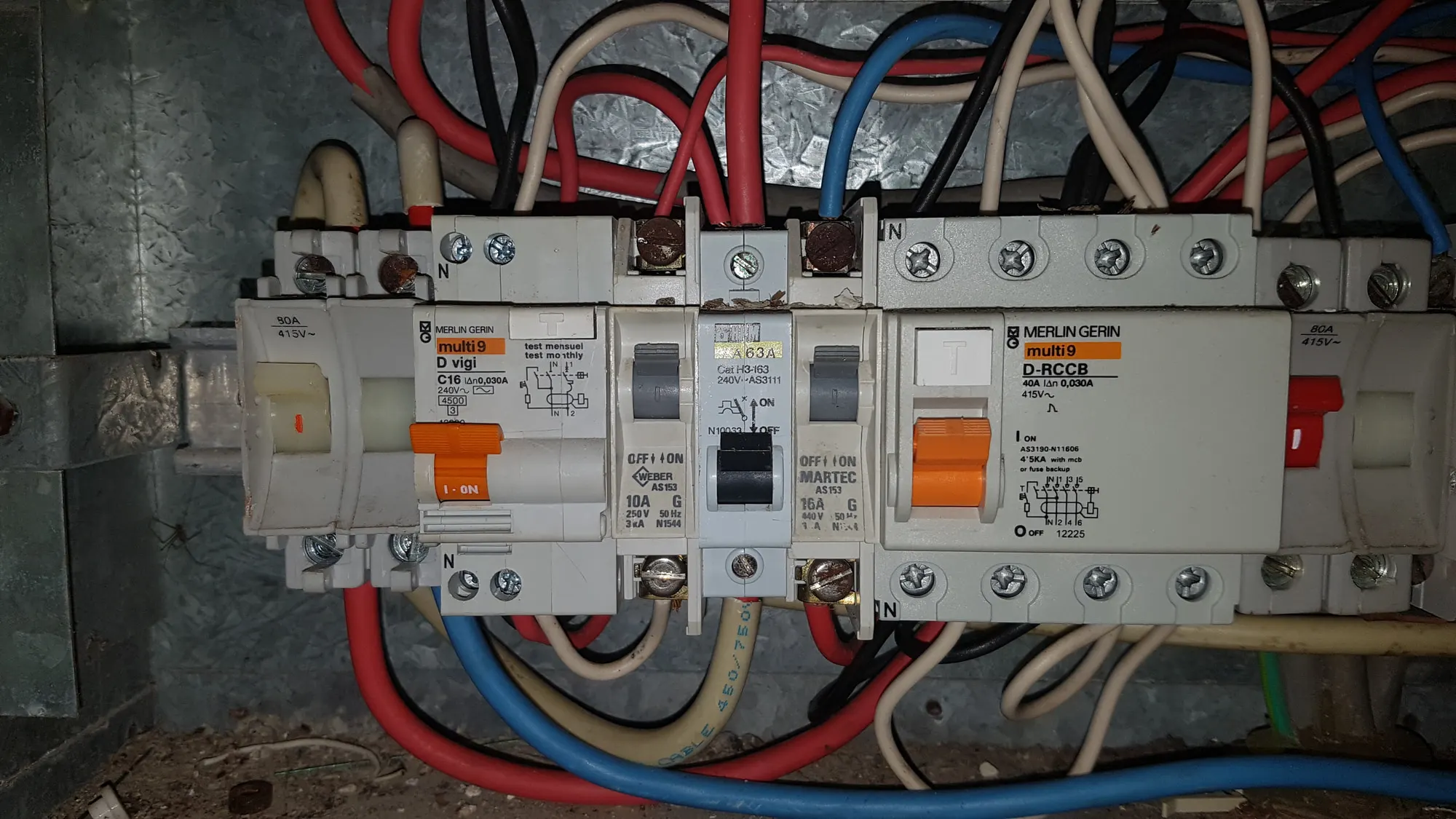
Go and look at your switchboard. What is on it decides what happens to somebody in your house who touches something they should not.
There are four generations of device out there and plenty of Douglas Shire houses have more than one of them on the same board. They are not interchangeable and they do not do the same job.
Ceramic fuses
The original. A ceramic carrier with fuse wire in it, in a few different sizes, still sitting in a great many older boards here.
A fuse protects the circuit. It cuts the power when the current through it is too high, which covers both a slow overload and a dead short, and that is what stops a cable overheating inside a wall. What it will not do is protect a person from an electric shock, and it never could.
Plug-in circuit breakers
The next development, and the one to be most wary of. A plug-in breaker does the same job as a fuse without the fuse wire, which is convenient.
The trouble is how easily one gets replaced with the wrong rating. It takes seconds, it looks entirely correct afterwards, and the result is a circuit protected above the capacity of the cable feeding it. That is how a circuit gets overloaded without anything tripping, and it is a genuine fire risk. Like a fuse, it offers a person no protection from electric shock. To be plain about it: changing a protective device is licensed electrical work, whatever it looks like from the front of the board, and it is not a job to have a go at.
The safety switch, or RCD
The residual current device was the first device designed to protect people rather than wiring, and it is the important one.
It works by comparing the current flowing out to the current coming back. If some of it is going somewhere else, which is what is happening when it is going through a person, it cuts the power to that circuit in a fraction of a second. Quickly enough to matter, whether the fault is a damaged power point or a hairdryer that has finally given up. It does not make electricity safe to touch. It very substantially reduces the chance that touching something faulty kills you, which is not the same promise and is still the most valuable device on the board.
Two things it does not do. It does not protect the circuit: an RCD watching for leakage will not notice an overloaded cable, so a board with safety switches and nothing else still carries a fire risk. And it cannot help someone who has managed to get across both wires at once, active and neutral together, because the current still balances and there is nothing for it to detect. That is rare, and it is the reason nobody should treat a safety switch as permission to poke about.
Combination devices, which do both
The current answer combines the two functions in one device, per circuit. The circuit gets overload protection and the people on it get earth leakage protection.
Doing it per circuit rather than across the whole board has a practical benefit that owners notice immediately: nuisance tripping largely goes away. A single faulty appliance trips its own circuit instead of taking out half the house, which also makes finding the fault trivial rather than a process of elimination in the dark.
How to tell what you have
A safety switch has a test button on it. That is the quickest check anyone can do without opening anything.
Press it. The switch should trip immediately. If it does, reset it and you know that circuit is protected and the device works. If nothing happens, ring an electrician. If there is no test button anywhere on the board, you do not have a safety switch at all, whatever else is on there.
Do that test every three months, which is what Queensland's Electrical Safety Office recommends. It takes about a minute, and the easiest way to remember is to do it when the quarterly power bill arrives.
What to do about it
If the board has fuses or plug-in breakers and no test button, the upgrade is worth doing and it is not a large job. A switchboard upgrade replaces the protection, generally improves the labelling to something a future electrician can read, and brings the board up to current standard.
If you are not sure what is on your board, send us a photograph of it with the cover on. We can usually tell you from that, and it costs you a text message.
Rewritten from “A letter from John gets Jim fired up!”, published on the BH Electrics blog in September 2019. The original was a script for a video presented by a character; the explanation is what was worth keeping.
The work behind this
What we do about it
Straight answers
Questions people ask about this
What is the difference between a safety switch and a circuit breaker?
A circuit breaker protects the wiring. It cuts the power when too much current flows, whether that is a gradual overload or a dead short, which is what stops a cable overheating and starting a fire. A safety switch, or RCD, protects people. It compares the current flowing out with the current returning and cuts the supply in a fraction of a second if the difference suggests electricity is flowing through a person. You need both, and a board with only one of them is only half protected.
How do I know if my house has a safety switch?
Look for a test button on the switchboard. Safety switches have one; fuses and ordinary circuit breakers do not. Press it and the switch should trip immediately, then reset it. If nothing happens when you press it, call an electrician. If there is no test button anywhere on the board, the house has no safety switch.
How often should I test my safety switch?
About every three months. Queensland's Electrical Safety Office recommends the quarterly test and it takes a minute: press the test button, confirm the switch trips, reset it. A safety switch that does not trip when tested is not protecting anybody.
Are old ceramic fuses dangerous?
They are not dangerous in themselves, but they offer limited protection to the wiring and no protection at all to people. A house with ceramic fuses and nothing else has no earth leakage protection, so a faulty appliance or a damaged power point can deliver a shock with nothing on the board to stop it. That is the case for a switchboard upgrade.
More advice
Other things worth knowing
Where we have done it
Jobs that used this work
Need a licensed electrician who turns up?
Leave us a number and we will ring you back, or send the whole job through and we will quote it.