Advice · Storm season
Generator changeover switches, and which one your building needs
You bought the generator. Nobody mentions the next part, which is how its power reaches everything already wired into the building. That is most of what you will miss when the lights go out.
The problem with a generator and a pile of extension leads
You have done the sensible thing and bought a generator, so the house or the business can keep running when the power goes out after a storm or a cyclone. Good. Now work out how the power gets from it to everything you use.
Extension leads will run a fridge and charge a phone. They will not run anything hard-wired, which is to say the lighting, the ceiling fans, the hot water system and the cooling. In a Far North Queensland summer the air movement is not a luxury item, and a house you cannot light after dark is a house you cannot really use.
Leads are also a hazard in their own right, spread across wet floors and through doorways. And running a lead indoors means a door or a window propped open for the cable, which lets in the noise and leaves the building open at exactly the time you would rather it was not.
What a changeover switch actually does
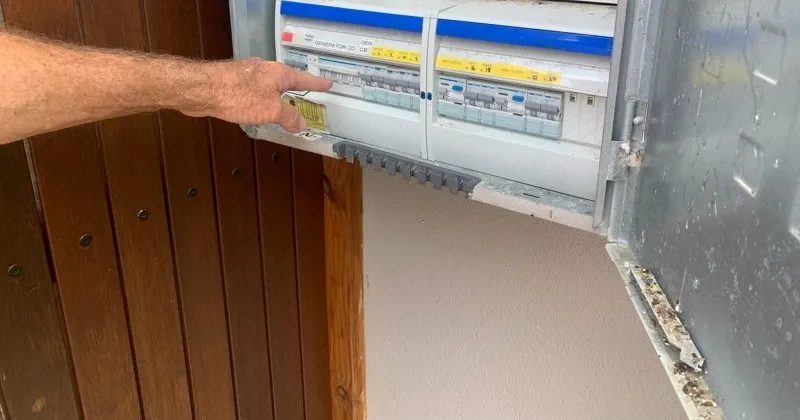
A changeover switch connects the generator to the building's switchboard and transfers the supply from the mains to the generator. The circuits that are already wired into the building keep working, fed from the generator instead of the grid.
Critically, it makes that transfer safe. The switch physically prevents the generator and the mains supply from ever being connected at the same time, which is what stops generator power being pushed back out into the network. That is a serious hazard to line workers, and it is the reason this is licensed work rather than something to improvise.
They are increasingly common in both homes and businesses here, and they are often bought at the same time as the generator to guarantee the two are matched. If you already have a generator, an electrician can assess it and specify a switch to suit.
Automatic changeover switches
An automatic switch senses the loss of mains power, starts the generator and transfers the supply, with nobody doing anything. Power comes back in seconds and returns to mains when the grid does. It only works with a generator built to start on a signal, which most portable units are not, so the switch and the generator get chosen together.
You find them where continuous power matters for safety or for stock: hospitals, schools, large kitchens, factories, shopping centres, anywhere a few hours of darkness costs more than the switch did.
- Feeds the hard-wired circuits, so lighting and fans come back on, subject to what the generator itself can carry
- Starts the generator and transfers the supply without anyone present
- More complex than a manual switch, and needs servicing every year to stay reliable
- Costs more to install, which is worth weighing against lost trade and spoiled stock rather than against the price of a manual switch
Manual changeover switches
A manual switch does the same heavy lifting without the automation. The generator is connected to the switchboard and somebody throws the switch to transfer the supply. It is not complicated, but it does require a person on site who knows how.
For most homes and many small businesses this is the right answer. It is considerably cheaper, there is far less to go wrong, and it still runs everything the extension leads could not.
- Feeds the same hard-wired circuits as an automatic switch
- Much cheaper to install, and no annual service on the switch itself. The generator still needs running and servicing, or it will not start on the day
- Somebody has to be there to connect the generator and throw the switch
If the building already has a system on the roof
We do not install or service solar, but a great many buildings here have it, and it changes this conversation. An inverter and a generator both want to be the source of supply, and getting that wrong can damage one or the other.
So mention it when you ring. The solar side stays with whoever installed it; what we need to know is that it is there, so the changeover arrangement suits it. Far easier to allow for at the start than to discover during the first blackout of the season.
When to do it
Before the season, not during it. The season runs from November to the end of April, and once a warning is current every electrician in the region is committed and the wholesalers are out of stock. A changeover switch is a couple of hours of work in a quiet week and an impossibility in a busy one.
Rewritten from “Keep Powering on in a Power Outage”, published on the BH Electrics blog in November 2020, and from an unpublished Word draft on changeover switches.
The work behind this
What we do about it
Straight answers
Questions people ask about this
Can I just run my house off a generator with extension leads?
You can run portable appliances that way, and plenty of people do. What you cannot run is anything hard-wired: the lighting, the ceiling fans, the hot water system and the cooling. A changeover switch removes that problem by feeding the building's own circuits instead. What those circuits will actually run once they are live is a separate question, and it depends on the size of the generator rather than on the switch.
What is the difference between a manual and an automatic changeover switch?
An automatic switch detects the loss of mains power, starts the generator and transfers the supply on its own. A manual switch does the same transfer but needs a person to connect the generator and operate it. Automatic suits places where continuous power protects safety or stock and is worth its yearly service. Manual is much cheaper, has far less to go wrong, and is the right choice for most homes and many small businesses.
Does a generator changeover switch have to be installed by an electrician?
Yes. It is licensed electrical work on the switchboard, and the switch exists partly to guarantee the generator and the mains supply can never be connected at the same time. Getting that wrong can push generator power back into the network, which is a serious hazard to the people working on the lines.
When should I install a changeover switch in Far North Queensland?
Well before the season. Once a cyclone warning is current every electrician in the region is committed and the suppliers are out of stock. It is a short job in a quiet week, so book it somewhere between May and October, not in the week you need it.
More advice
Other things worth knowing
Need a licensed electrician who turns up?
Leave us a number and we will ring you back, or send the whole job through and we will quote it.